
THE COMPUTER-TO-HUMAN CONNECTION
A historical journey toward computers that sense, evaluate and respond personally to people.
An Architecture Advancing How Computers Interact with People in the AI Era
FINALSTEP AI preserves the history of an adaptive personalised instructional architecture developed from an idea conceived by Australian inventor and professional golfer Richard Baker in the early 1990s.
At its centre was a difficult objective: enable a computer to obtain information about an individual's golf swing, or an object controlled by the individual such as a golf club; compare and evaluate that information against a stored expert's golf swing; and draw upon stored audio instructional comments from the expert. A database would then determine the appropriate audio and visual information to communicate, automatically produce a personalised audio-visual presentation, and deliver that presentation back to the individual over a communications network in near real time. Achieving this complete process with the computer and communications technology available in 1990 presented an extraordinary technical challenge.
The Central Concept
The architecture was conceived as more than a system for displaying stored information or allowing a person to operate a computer. Its purpose was to enable the computer to participate actively in the instructional process.
Information concerning a person's current performance could be obtained and compared with information representing expert knowledge or a desired performance. The computer could evaluate that comparison, determine what was relevant to the individual, and generate a personalised audio-visual instructional presentation.
In this way, the information presented by the computer could be determined by the needs of the individual rather than being the same predetermined presentation for every user.
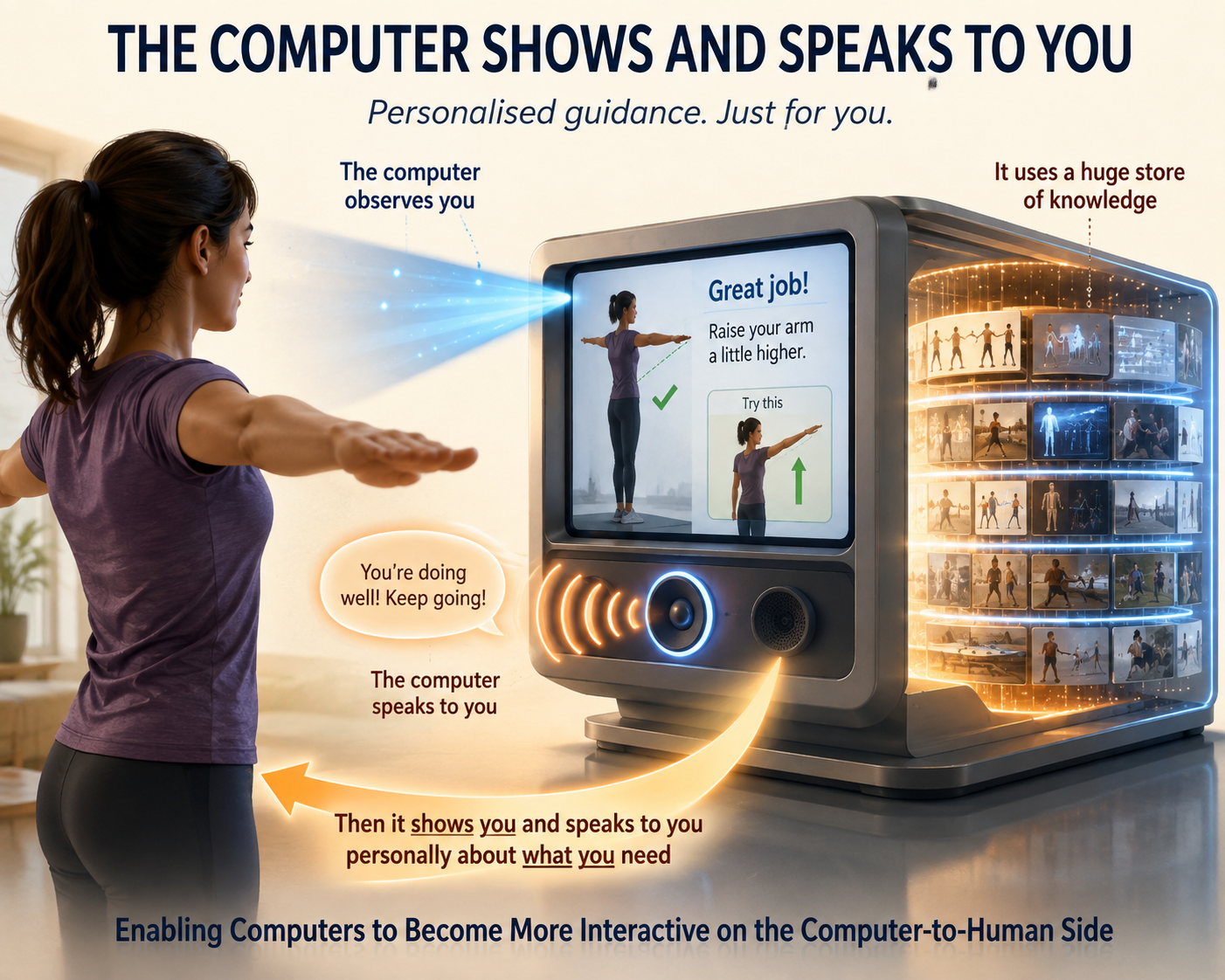
From Computer Presentation to Computer-Human Interaction
Traditional computer systems largely required people to request information, select predetermined material, or interpret information displayed by the computer.
The architecture developed by Richard Baker advanced the computer-to-human side of that relationship. The computer could receive information concerning the individual, use a knowledge source to compare and evaluate that information, determine an appropriate response, and communicate personalised information back to the person.
The result was an architecture in which the computer could become an active participant in an instructional exchange rather than simply a passive source of stored information.
Development Beyond the Original Camera-Based Approach
In the original conception, Richard Baker envisaged camera and video technology as the practical means of obtaining information about a person's movement.
As the system was developed and practical limitations associated with camera-based motion tracking became apparent, Baker later recognised that other sensing technologies, including MEMS-based sensing, could also provide the movement information required by the instructional system.
In Baker's historical analysis, these developments changed the means by which movement information could be obtained rather than the underlying instructional process: obtaining current-performance information, comparing and evaluating it against stored knowledge, and providing personalised audio-visual guidance.
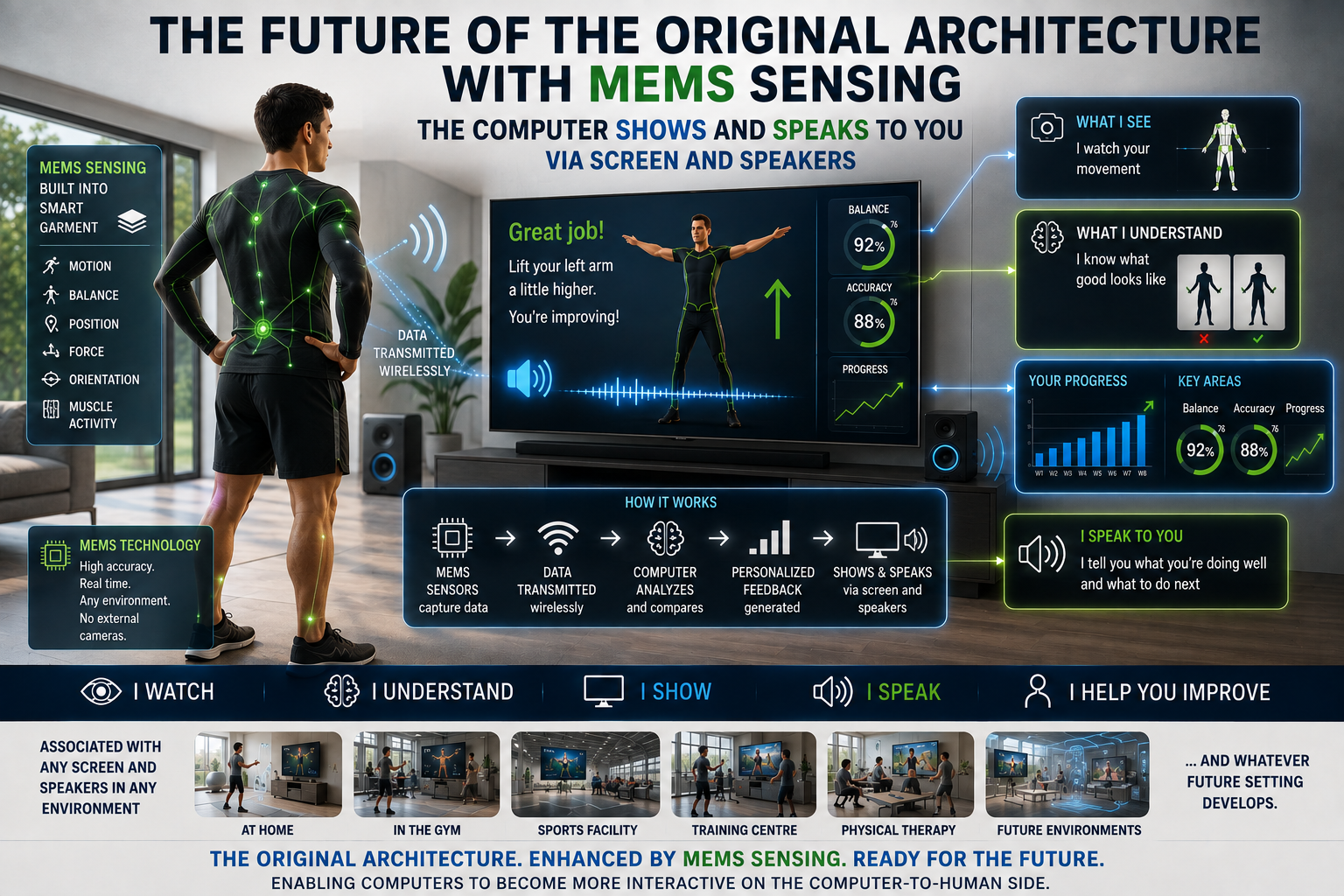
From Golf to Broader Personalised Audio-Visual Instruction
The original practical application arose from Richard Baker's experience as a professional golfer and golf instructor. Golf provided a clear example of how a human expert teaches: the expert observes an individual's performance, compares what they see with their own expert knowledge and experience, identifies what may need correction, and then provides appropriate instruction.
That instruction is naturally audio-visual. An expert may show the person how something should be performed - the visual instruction - while at the same time explaining what the person should change or do differently - the audio instruction.
Richard Baker recognised in 1990 that this process did not have to be limited to a golf professional standing beside a student. If an expert's knowledge, visual demonstrations and spoken instructional comments could be stored within a computer system, and information about an individual's own performance could be obtained and evaluated, the computer could determine which parts of that expert knowledge were relevant to that particular individual.
The architecture developed by Richard Baker sought to bring those elements together so that the computer could automatically produce and deliver personalised audio-visual instruction in near real time over a communications network.
This was the broader potential that made the original idea so compelling. Golf was the starting point, but the architecture was not inherently about golf. The same principle could potentially allow the knowledge and instruction of experts in many different fields to be made available to individuals remotely, with the information presented being determined by the needs and performance of each individual.
For Richard Baker in 1990, that realisation was the "WOW" moment: a computer might not simply display an expert's prerecorded information. It could use information about the individual to determine what that particular person needed to be shown and told, and then automatically assemble and communicate the appropriate personalised audio-visual instruction.
The Historical Journey
What began as an instructional concept developed into a long technological, patent and commercial journey.
The historical record includes early invention documents, prototype development, patent applications and granted patents, discussions with companies and institutions, technical development, commercial investigation, later products employing increasingly advanced sensing technologies, and eventual patent litigation.
FINALSTEP brings those materials together so that the development of the architecture can be examined chronologically and alongside the original documentary evidence.
Patents, Commercial Technology and Litigation
The archive follows the development of the invention through its patent history and the later emergence of commercial technologies capable of performing increasingly sophisticated personalised interactive functions.
It also preserves the documentary record surrounding Richard Baker's efforts to protect and enforce his intellectual property, including the litigation that followed.
The evidence is presented separately from commentary wherever practical so that readers can examine the underlying historical documents and reach their own conclusions.
The Architecture and the AI Era
Artificial intelligence has greatly expanded the ability of computers to analyse information, recognise patterns, draw upon large knowledge sources and generate responses appropriate to an individual.
Against that background, the architecture developed by Richard Baker has particular historical relevance. Its central concept was that a computer could obtain information concerning an individual, compare and evaluate that information using a knowledge source, determine what information was appropriate, and communicate a personalised audio-visual presentation back to that person.
The sensing technologies, computing power and artificial intelligence available today are vastly more advanced than those available when the architecture was conceived. The underlying objective, however, remains recognisable: advancing how computers interact with people by making the information they communicate responsive to the individual.
Why FINALSTEP Exists
FINALSTEP AI has been created to preserve this history in a structured and accessible form.
It is both a historical reference archive and a record of the development of an idea across more than three decades. The site brings together the invention, its technical principles, patents, selected correspondence, commercial history, litigation and selected public documentary evidence.
The purpose is not simply to describe what happened, but to preserve the documents necessary for future readers to understand when the ideas emerged, how they developed, how the technology evolved, and why the architecture may remain relevant as computer-human interaction continues to advance in the AI era.
Version 1.0 - About FINALSTEP AI
Last Updated: 14 September 2026